The Challenge
An enterprise R&D organisation served multiple internal and external clients with knowledge-intensive deliverables, research reports, technical assessments, regulatory submissions, and competitive intelligence. Every new client engagement required building a custom knowledge base, configuring retrieval and synthesis logic, and validating that the resulting system produced trustworthy outputs in the client's specific domain.
The team had built several one-off RAG implementations, each tuned for a different client. The pattern was painful: every new project started from scratch, took weeks of engineering effort to stand up, and produced a system whose evaluation methodology was bespoke and hard to defend during client reviews. Knowledge gained from one engagement rarely transferred to the next, and senior engineers were spending most of their time on plumbing rather than on the genuinely interesting problems of domain adaptation and evaluation design.
The organisation needed a consistent, reusable framework, something that could ingest and retrieve knowledge across many file formats, adapt to multiple industries, and provide a defensible evaluation methodology that clients could trust. The framework also had to be governed and audit-ready, because several of its target industries had strict requirements around how AI-generated artefacts were produced and reviewed.
Our Solution
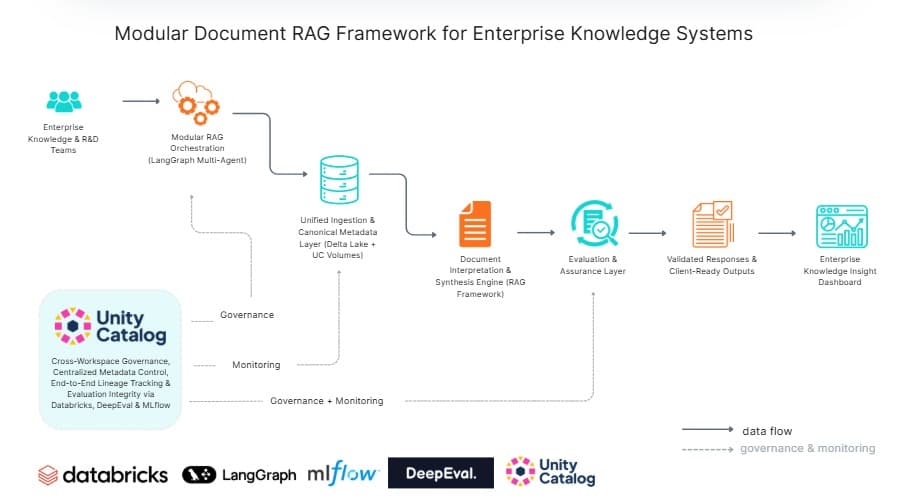
We developed a LangGraph-based modular Document RAG Framework optimised for scalability, governance, and continuous evaluation, designed from the start to be reused across engagements rather than rebuilt for each one.
The ingestion pipeline unified structured and unstructured formats including PDF, DOCX, PPTX, and XLSX through a canonical metadata schema stored in Unity Catalog Volumes. Every document, regardless of source format, ended up in a common shape with consistent metadata about its source, version, ownership, and access controls. This single decision collapsed weeks of per-engagement format-handling work into a configuration step.
Each query flow passed through an adaptive prompt strategy selector that chose between direct, contextual, or hybrid synthesis styles depending on the question type and the retrieved context. Direct synthesis was used for factual lookups; contextual synthesis was used for questions that required reasoning over multiple chunks; hybrid synthesis combined both for complex questions that mixed lookup and reasoning. The selector was itself configurable per engagement, so domain experts could tune behaviour without touching code.
Model outputs were benchmarked through DeepEval Faithfulness metrics and compared against golden datasets tracked in MLflow Evaluate. Each new engagement started with a small set of golden questions provided by the client, and the framework automatically scored every model version against that set, giving both the R&D team and the client a defensible evaluation baseline that could evolve as the project matured.
The entire framework was packaged as composable modules with clean interfaces, so an engineer starting a new engagement could clone the baseline, swap in client-specific data sources and prompts, and have a working production-grade RAG system in hours rather than weeks. The framework has since become the team's default starting point for every new generative AI project.
Modular Document RAG Framework for Enterprise Knowledge Systems Architecture showing LangGraph multi-agent orchestration, unified ingestion with Delta Lake and Unity Catalog Volumes, document interpretation and synthesis, evaluation and assurance layer, and enterprise knowledge insight dashboard