The Challenge
A logistics organisation operating across multiple distribution sites needed to monitor people and vehicle movements in real time using its existing camera network. The motivations were a mix of operational optimisation (understanding throughput, identifying bottlenecks at loading bays, counting vehicle visits) and safety (detecting unauthorised access, validating PPE compliance in restricted zones, understanding pedestrian-vehicle interaction patterns).
The organisation already had a substantial investment in IP cameras, networking, and storage at each site, but the cameras were essentially passive recorders. Reviewing footage was a manual, after-the-fact process, and there was no way to extract structured analytics from the raw video feed. Privacy was also a pressing concern, any solution had to blur faces before storing imagery to comply with privacy obligations, particularly in jurisdictions with strict CCTV rules.
The team also needed flexibility in how the system was deployed. Some sites had reliable connectivity and could stream to the cloud; others were remote and needed to process on-edge with periodic sync. Whatever solution was built had to support both modes without forcing a rebuild.
Our Solution
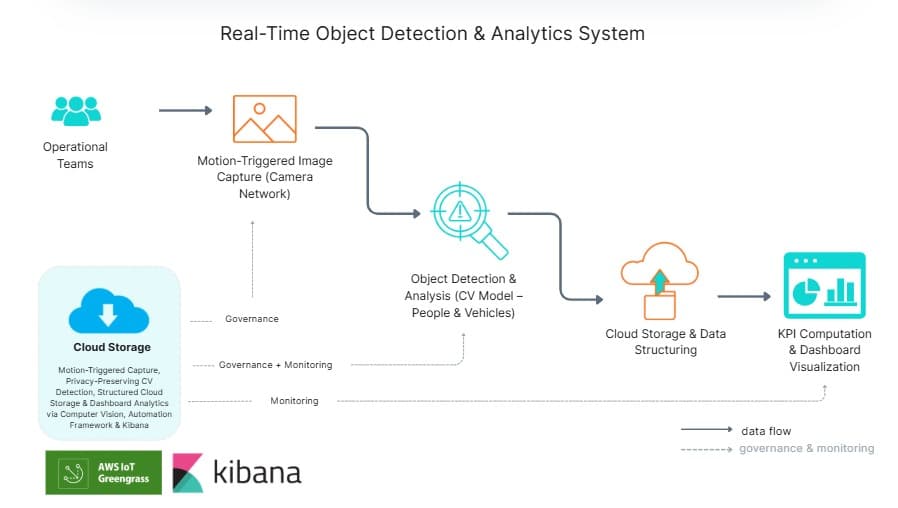
We designed and implemented a five-stage workflow covering object-detection model development, capture pipeline automation, cloud storage configuration, R&D tuning, and dashboard visualisation.
The camera network triggers image capture on motion rather than streaming continuously, dramatically reducing bandwidth and storage costs. Captured frames are analysed by a CV model trained to detect people and vehicles with high precision in the lighting and angle conditions specific to each site. As soon as detection is complete, faces are blurred at the edge, critically, the unblurred imagery never leaves the camera node, and only privacy-compliant frames are passed downstream.
Results are stored in cloud storage with full metadata about the detection event: timestamp, site, camera, object class, confidence score, bounding box coordinates, and any contextual flags. The pipeline supports both serverless processing (for sites with reliable cloud connectivity) and hosted processing (for sites that need to operate independently and sync periodically), depending on user preference and site constraints. The same downstream analytics layer consumes both modes without modification.
A data cleaning and structuring layer normalises detection events into a queryable format, then feeds a dashboard layer where KPIs are computed and visualised in near real time. KPIs include detection counts by time slot, percentile distributions of vehicle traffic, time-of-day correlation analysis, and dwell-time estimates in defined zones. The dashboards were built in Kibana for compatibility with the organisation's existing observability stack, and used AWS IoT Greengrass on the edge to coordinate distributed processing across sites.
The entire system was designed as a reusable framework rather than a one-off project, combining CV detection, capture automation, cloud storage, and dashboarding into a stack that the organisation could roll out to additional sites with minimal incremental engineering effort.
Real-Time Object Detection & Analytics System Architecture showing motion-triggered image capture, computer vision model for people and vehicle detection, cloud storage and data structuring, KPI computation, and dashboard visualization with AWS IoT Greengrass and Kibana